
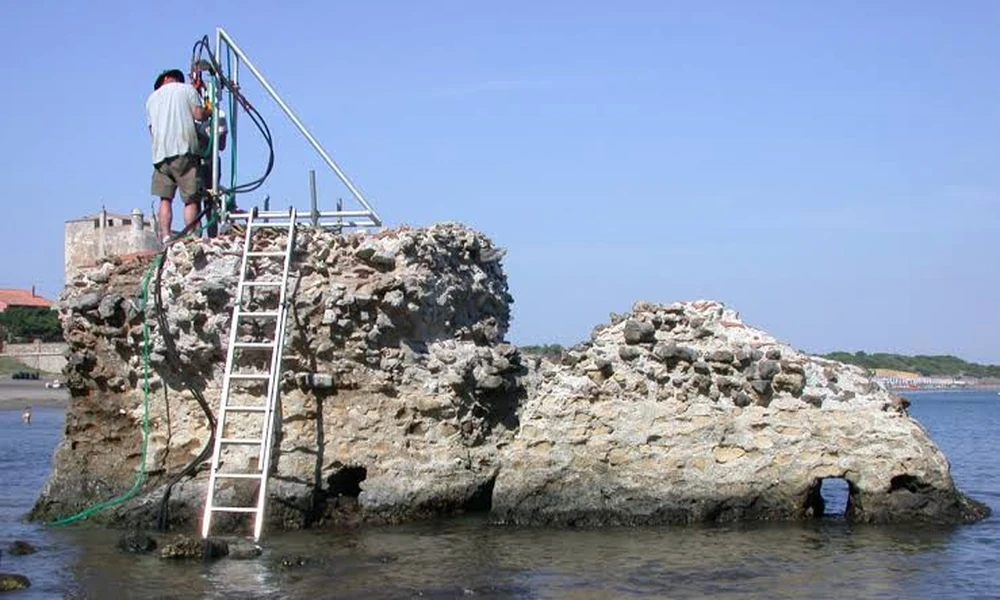
Walk past a beachfront parking garage that’s only 30 years old and compare it to a comparable inland structure. The coastal one looks twice its age. Chunks missing. Rust stains streaking the columns. Concrete peeling away in sheets. That’s not poor construction. That’s chemistry, and the ocean wins every time you ignore it.
Understanding why coastal concrete deteriorates so much faster than inland concrete is the first step toward protecting the buildings, decks, and structures you own or manage. The science is genuinely fascinating, the stakes are high, and the fix is almost always cheaper when you catch problems early.
The Ocean’s Secret Weapon: Chloride Ions
Salt air does damage that’s invisible for years. The mechanism works like this: chloride ions from seawater and ocean spray penetrate the tiny pores and micro-cracks in concrete and migrate inward until they reach the steel reinforcing bars embedded inside. Once enough chloride accumulates around that rebar, corrosion starts.
In a maritime environment, chloride-induced corrosion of reinforcing bars is the leading cause of degradation in reinforced concrete components. Corrosion begins when a threshold concentration of chlorides builds up on the surface of the reinforcement, often due to insufficient concrete cover. That corrosion then spreads through the bar, decreasing structural capacity and triggering cracking and spalling as the corrosion products expand outward.
That expansion is the part most people don’t realize. Rust occupies far more volume than the original steel it replaces, so corroding rebar exerts pressure on the surrounding concrete from the inside. The concrete doesn’t just stain. It fractures and sheds. By the time you see a chunk fall off a parking deck column, the corrosion process likely started a decade earlier.
The peer-reviewed study published in Scientific Reports by Nature (2022) on coastal building foundations found that damages from saltwater-driven corrosion may not be detected in a timely fashion nor be insured, leading to significant and unanticipated expenses for building owners. That’s a real financial exposure, and it scales with how close a property sits to open water.
Hawaii: A Perfect Storm for Accelerated Decay
Every coastal location deals with chloride exposure, but Hawaii’s conditions stack the deck harder than most. The islands sit in a warm, humid, salt-laden environment year-round. There’s no winter freeze-thaw cycle to give concrete a break. Salt spray, UV radiation, and persistent moisture work on structures every single day, all year long.
The infrastructure picture reflects this. Common challenges facing Hawaii’s infrastructure across the board include aging infrastructure, lack of funding, and sea-level rise. The majority of Hawaii’s infrastructure has been operating beyond its useful life, with some components of systems over 100 years old. The American Society of Civil Engineers graded Hawaii’s overall infrastructure a D+ in its 2019 Report Card, a grade that still stands , according to reporting on the 2025 national update. You can review the detailed breakdown in the ASCE 2019 Hawaii Infrastructure Report Card.
For building owners and property managers on Oahu and the neighboring islands, that context is critical. A structure built 50 years ago was designed without today’s understanding of galvanic corrosion protection. It was also designed for service conditions that didn’t account for the cumulative chloride exposure it’s absorbed since then.
The Salt-Age-Cost Triangle
Here’s a framework worth keeping in your back pocket. Think of every coastal concrete structure as sitting inside a triangle with three corners: Salt Exposure, Structure Age, and Repair Cost. These three variables interact in a compounding, not linear, way.
- Low salt exposure plus a young structure: minimal risk, routine maintenance suffices.
- High salt exposure plus a young structure: accelerated risk, but intervention is inexpensive and effective.
- High salt exposure plus an aging structure: the most dangerous corner. Corrosion is already deep, repair scopes are large, and deferred action multiplies cost fast.
- Low salt exposure plus an aging structure: manageable, but never ignore it. Carbonation of the concrete still degrades the pH barrier protecting rebar over time.
Most Hawaiian high-rises, resort properties, and parking structures land in the third corner of that triangle. That’s not a verdict, it’s a starting point for an honest conversation about condition assessment and repair sequencing.
| Salt Exposure | Structure Age | Urgency Level | Recommended Action |
|---|---|---|---|
| Low | Under 20 years | Low | Annual visual inspection |
| High | Under 20 years | Moderate | Chloride testing, preventive sealing |
| Low | 20 to 50 years | Moderate | Condition assessment, spot repairs |
| High | 20 to 50 years | High | Full structural assessment, corrosion mitigation |
| High | Over 50 years | Critical | Immediate professional evaluation, restoration scope |
What Professional Concrete Restoration Actually Involves
A lot of building owners picture concrete repair as a patching job, someone comes out with a bag of premix and fills the holes. Real structural restoration is a completely different discipline. Done right, it addresses the corrosion process itself, not just the visible symptom.
Proper remedial work includes removing all chloride-contaminated and carbonated concrete back to sound substrate, treating or replacing corroded rebar, applying corrosion inhibitors, installing galvanic protection systems like embedded zinc anodes, and using repair mortars engineered to match the electrochemical behavior of the surrounding concrete. Skipping any of those steps just gives corrosion a head start on the new patch.
“Implementing corrosion mitigation measures is a fundamental requirement of concrete repair projects. Any other approach would be much less cost-effective.”
– Consensus position of the International Concrete Repair Institute (ICRI), the recognized industry body whose guidelines govern professional structural restoration work.
That’s why contractor selection matters so much. Choosing a crew that understands ICRI protocols versus one that doesn’t is the difference between a repair that lasts 20 years and one that fails before your next reserve study. Experienced structural rehabilitation contractors in Hawaii follow those guidelines precisely because the island environment punishes shortcuts harder than almost anywhere else on the mainland.
The Coastal Concrete Condition Assessment Checklist
If you manage or own a coastal concrete structure, run through this list at least once a year. Do it yourself as a first pass, then bring in a professional for anything that triggers a flag.
- Surface spalling or delamination: Any area where concrete has separated in layers or chunks, even small ones, signals active corrosion underneath.
- Rust staining: Brown or orange streaks running down a surface trace back to corroding rebar. The stain is already outside the concrete, meaning the rebar inside is well along.
- Crack width and pattern: Hairline cracks under 0.3 mm are often cosmetic. Cracks wider than that, especially in a map or alligator pattern, warrant professional evaluation.
- Hollow sound on tap: Use a hammer or a coin. A dull, hollow resonance instead of a solid ring means the concrete behind that spot has delaminated from the substrate.
- Exposed or staining rebar: Any visible steel is an emergency. Call a restoration contractor the same week, not the same quarter.
Growing Demand for Skilled Repair Work
The skilled labor side of this industry is growing fast. The U.S. Bureau of Labor Statistics projects that overall employment of construction laborers and helpers will grow 7 percent from 2024 to 2034, much faster than the average for all occupations , according to its Occupational Outlook Handbook. Infrastructure repair and replacement are cited as primary drivers of that demand. For building owners, that growth projection matters because it reflects where the industry is putting resources: not just new construction, but keeping existing structures standing.
In Hawaii especially, where building new is expensive and space-constrained, extending the service life of existing concrete structures is often the most practical and cost-effective path. The ocean will keep doing what it does. The question is whether your concrete is protected against it, or quietly losing that fight.
Get a condition assessment scheduled before the next inspection cycle. What you find might surprise you, and what you avoid by acting early will certainly cost less than what happens if you don’t.